New version of the NICU Manual. Same content, new design. Tell us what you thinkOpen this page in the old version
Special ConsidersationsChapter 21
VLBW/ELGAN/ELBW Infants
Rouding Sheet
Section titled “Rouding Sheet”Thermoregulation and Heat Loss Prevention
Section titled “Thermoregulation and Heat Loss Prevention”Labor & Delivery / OR
Section titled “Labor & Delivery / OR”- Maintain L&D/OR temperature at 70-74℉
- Preheat the radiant warmer before birth and set on servo-control mode
- Use prewarmed blanket to dry the newborn during delayed cord clamping
- use prewarmed blanket to receive the newborn and dry under the warmer
- Place temperature probe as soon as baby is under the warmer
- Monitor temperature frequently (every 5-10 minutes) prior to transfer to the NICU
- Maintain axillary temperature between 36.5℃ - 37.5℃
- Place a thermal mattress under the blanket on the radiant warmer
- Wrap the baby in a polyethylene plastic bag or wrap (<28 weeks and/or < 1,000 grams)
- Place a prewarmed hat on the baby’s head (as soon as possible)
- Keep the newborn fully covered during resuscitation and stabilization
NeoDrape Wrapping During Delayed Cord Clamping
Section titled “NeoDrape Wrapping During Delayed Cord Clamping”Vaginal delivery
Section titled “Vaginal delivery”Cesarean delivery
Section titled “Cesarean delivery”Transport
Section titled “Transport”- Prewarm transport incubator
- Use warming measures such as thermal mattress during transport
- Prewarm the incubator before the infant arrives in the NICU
- Keep incubator humidity at 80% (<30 weeks and/or < 1,000 grams)
- Prewarm linens and other items
- Use thermal mattress if temperature is below 36.5℃
- Monitor temperature closely throughout procedures
- prewarm IV fluids
- Ensure ventilator heaters are set at a warm temperature before use
ELGAN/ELBW Respiratory Protocol
Section titled “ELGAN/ELBW Respiratory Protocol”Refer to ELGAN/ELBW Respiratory Support Protocol for the First 72 Hrs page
BPD bundle
Section titled “BPD bundle”Refer to No-BPD Prevention Bundle page
ELGAN/ELBW Gut Health Protocol
Section titled “ELGAN/ELBW Gut Health Protocol”Probiotics (Evivo) use
Section titled “Probiotics (Evivo) use”Refer to Probiotics (Evivo) page
Glycerin use
Section titled “Glycerin use”Administer 0.5 mL/kg every 12 hours until meconium is fully passed and stool transitions.
Screening
Section titled “Screening”Sepsis screening and empiric antibiotic use
Section titled “Sepsis screening and empiric antibiotic use”GA < 32 weeks and BW < 1,500g
Section titled “GA < 32 weeks and BW < 1,500g”- Blood culture
- 1 blood culture if no central line
- 2 blood cultures if central line is in place
- Empiric antibiotics
- Ampicillin and gentamicin if no other nephrotoxic medication or no signs of AKI
- Ampicillin and ceftazidime/cefotaxime if presence of other nephrotoxic medication or has/has had AKI
GA ≥ 32 weeks or BW ≥ 1,500g
Section titled “GA ≥ 32 weeks or BW ≥ 1,500g”- Blood culture: obtain 2 from different sites
- Empiric antibiotics
- Ampicillin and gentamicin if no other nephrotoxic medication or no signs of AKI
- Ampicillin and ceftazidime/cefotaxime if presence of AKI
Thyroid screening
Section titled “Thyroid screening”Indication
Section titled “Indication”Any of the following:
- BW ≤ 1,500g
- Same-sex if chorionic status not known
Timing
Section titled “Timing”- 2, 4, 6 weeks of life
- TSH only
Head Ultrasound
Section titled “Head Ultrasound”Pediatrics (2020) 146 (5): e2020029082. https://doi.org/10.1542/peds.2020-029082
Indication
Section titled “Indication”- GA < 31 weeks or BW < 1,500 grams
Timing
Section titled “Timing”- DOL7 & 30
Retinopathy of prematurity
Section titled “Retinopathy of prematurity”Pediatrics (2013) 131 (1): 189–195. https://doi.org/10.1542/peds.2012-2996
Indication
Section titled “Indication”Any of the following:
- GA < 31 weeks or BW ≤ 1,500 grams
- GA ≥ 31 weeks or BW > 1,500 grams with risk factors
Timing
Section titled “Timing”| Gestational Age at Birth, wk | Age at Initial Examination, wk |
|---|---|
| Postmenstrual | Chronologic |
| 22 (a) | 31 |
| 23 (a) | 31 |
| 24 | 31 |
| 25 | 31 |
| 26 | 31 |
| 27 | 31 |
| 28 | 32 |
| 29 | 33 |
| 30 | 34 |
| Older gestational age, high-risk factors (b) | |
| Shown is a schedule for detecting prethreshold ROP with 99% confidence, usually before any required treatment. |
Eye exam medications
Section titled “Eye exam medications”Use the PNL NICU EYE (ROP) EXAM MEDICATIONS IP SCAL order set. Default medications: Cyclomydril and Tetracaine.
- Cyclomydril requires at least 30 minutes prior to exam and lasts up to 4 hours
- Try to target timing to be given 1–2 hours before the scheduled exam
- You can order in advance, but remember to change the date/time
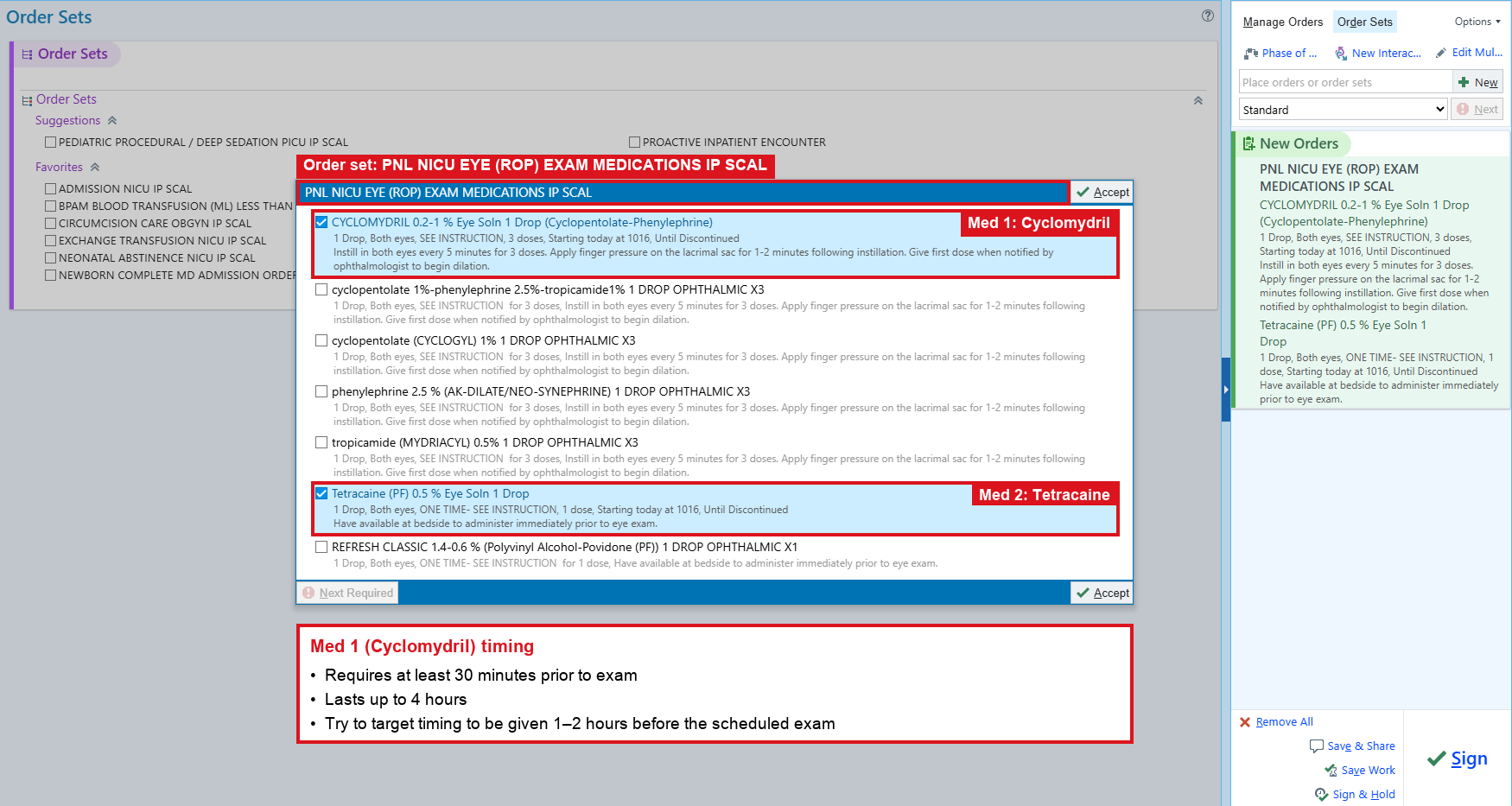
ROP exam medications order set.
Blood transfusion
Section titled “Blood transfusion”For all ELGAN and ELBW infants
Section titled “For all ELGAN and ELBW infants”- Obtain Type & Screen with confirmation ON ADMISSION
- one specimen from cord blood
- one speciment from umbilical line during line placement
- Obtain blood transfusion consent ON ADMISSION
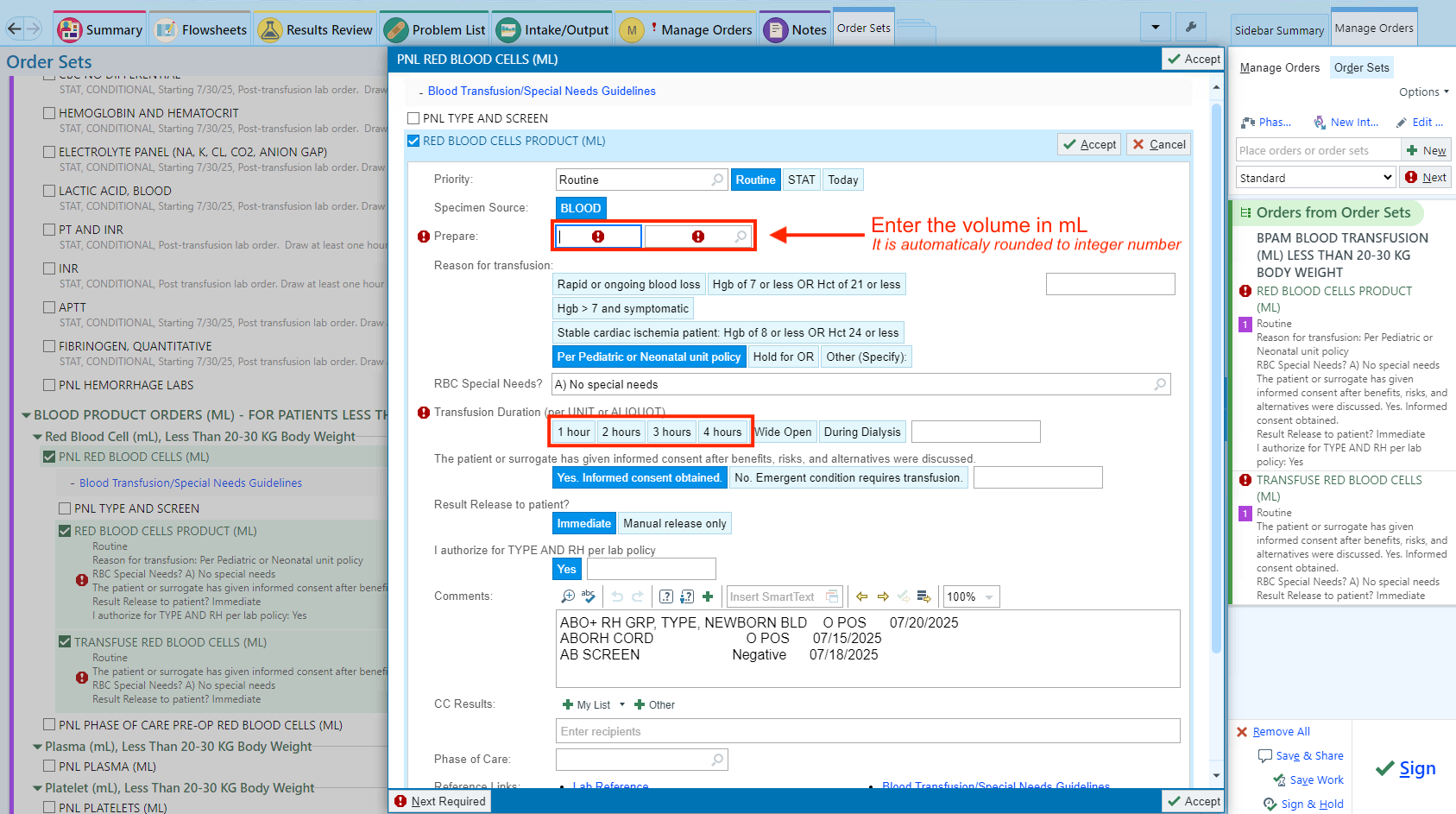
Ordering blood product
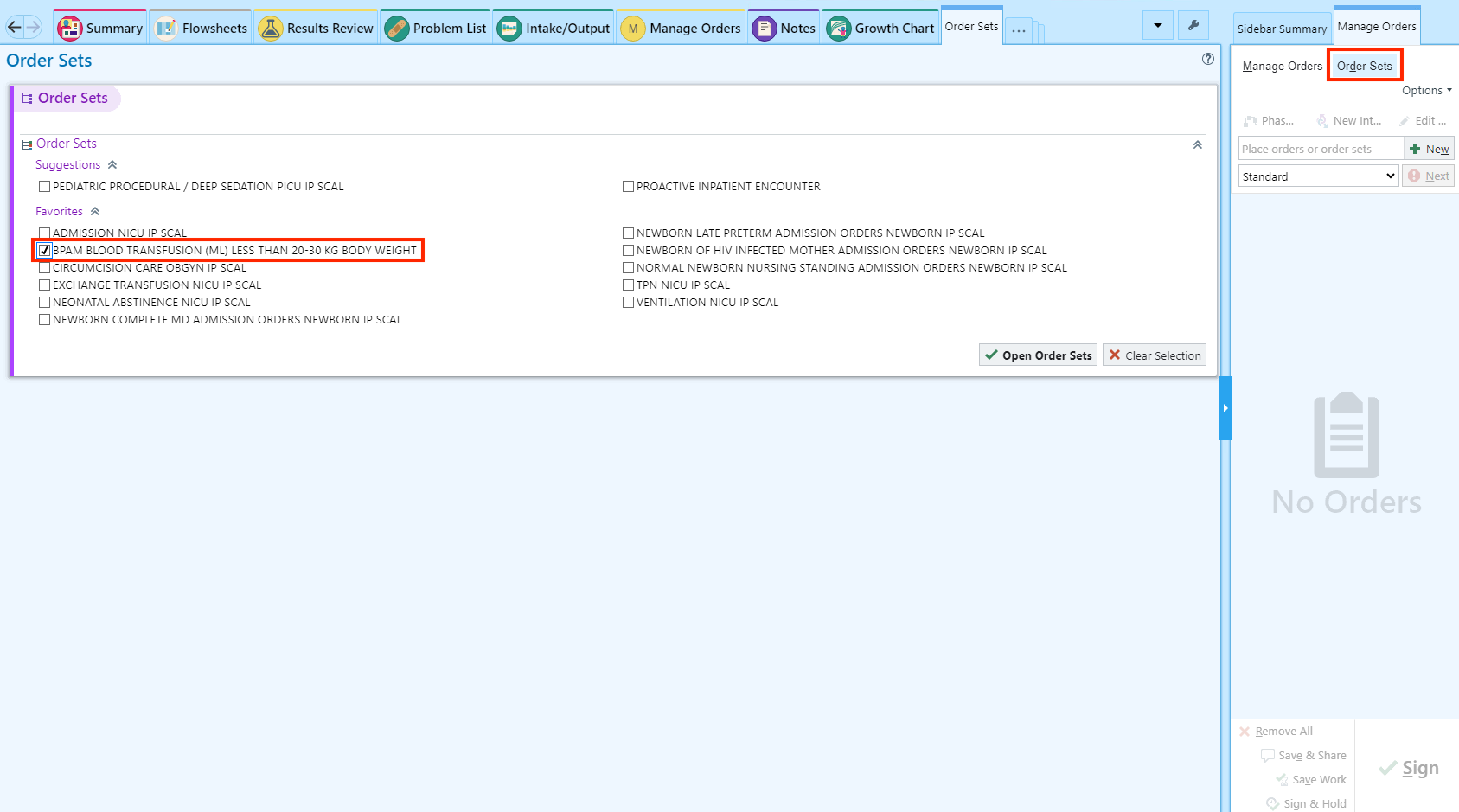
Section titled “Ordering blood product”- Use the BPAM orderset
- Select the blood product type
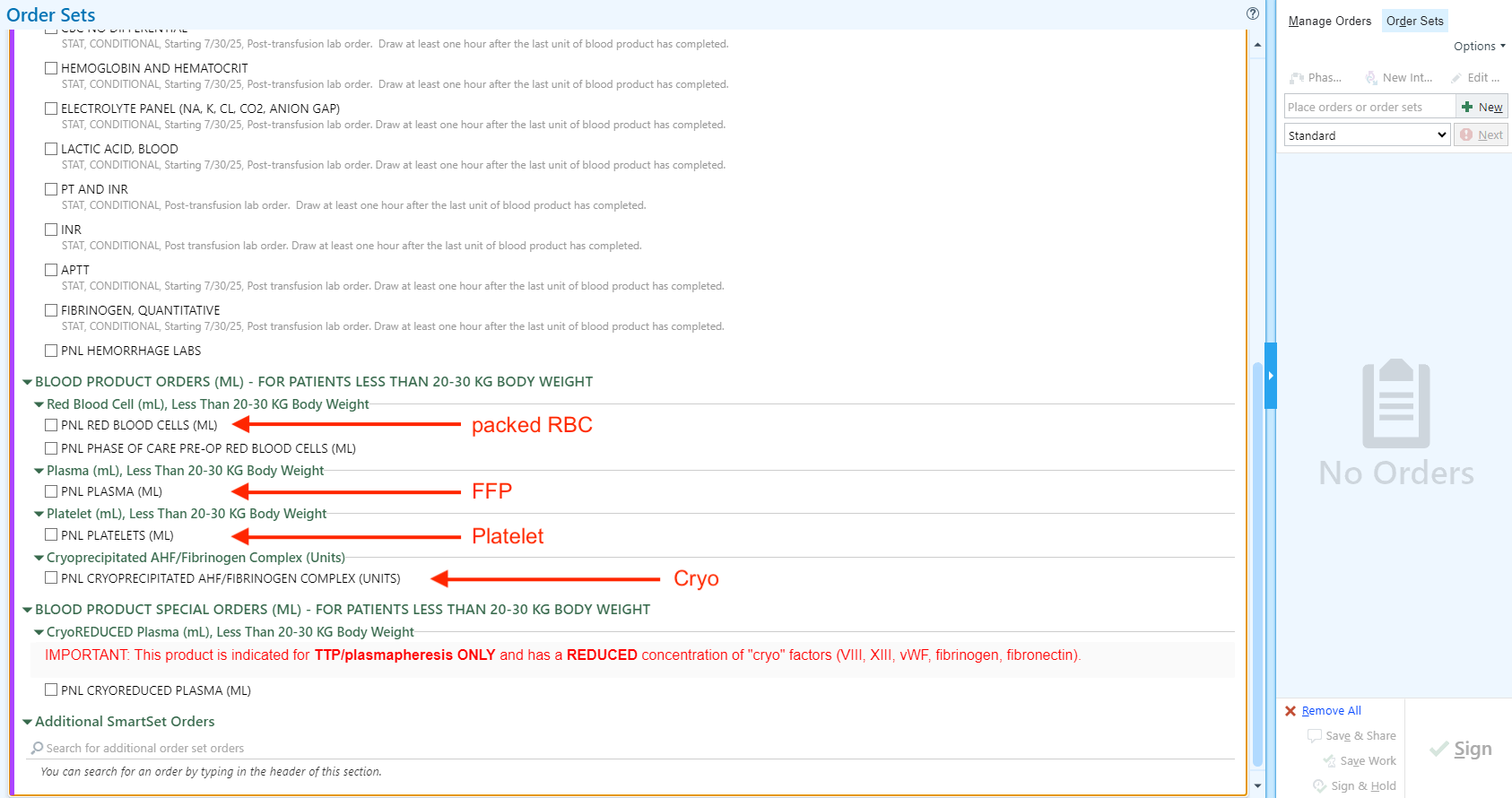
- Enter the volume and the duration
Prophylaxis
Section titled “Prophylaxis”Systemic fungal infection
Section titled “Systemic fungal infection”Fluconazole 3mg/kg/dose twice weekly for 6 weeks (42 days) or until central line removed, whichever comes first.
Neuroprotective Care
Section titled “Neuroprotective Care”First 72 hrs of life
Section titled “First 72 hrs of life”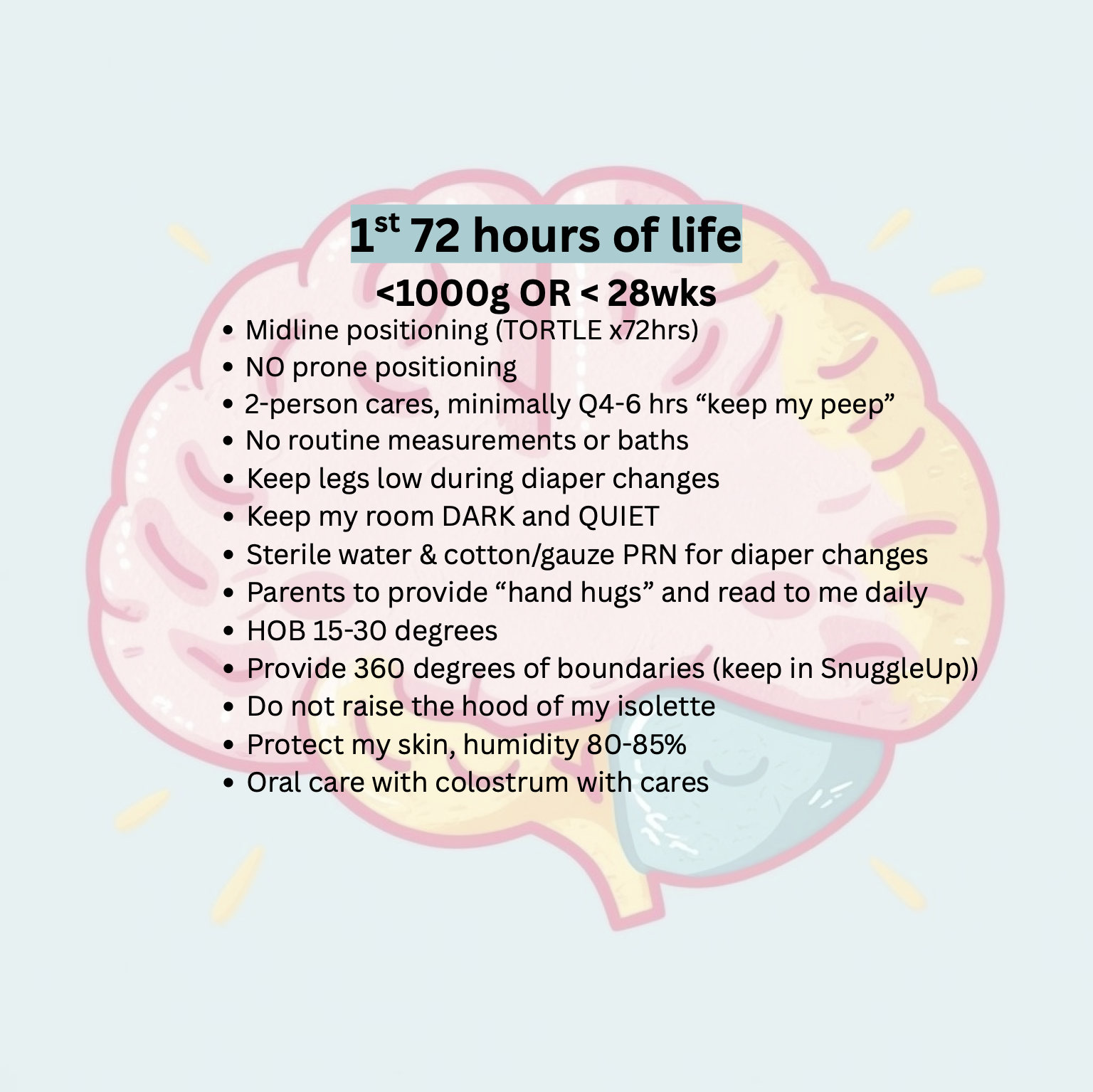
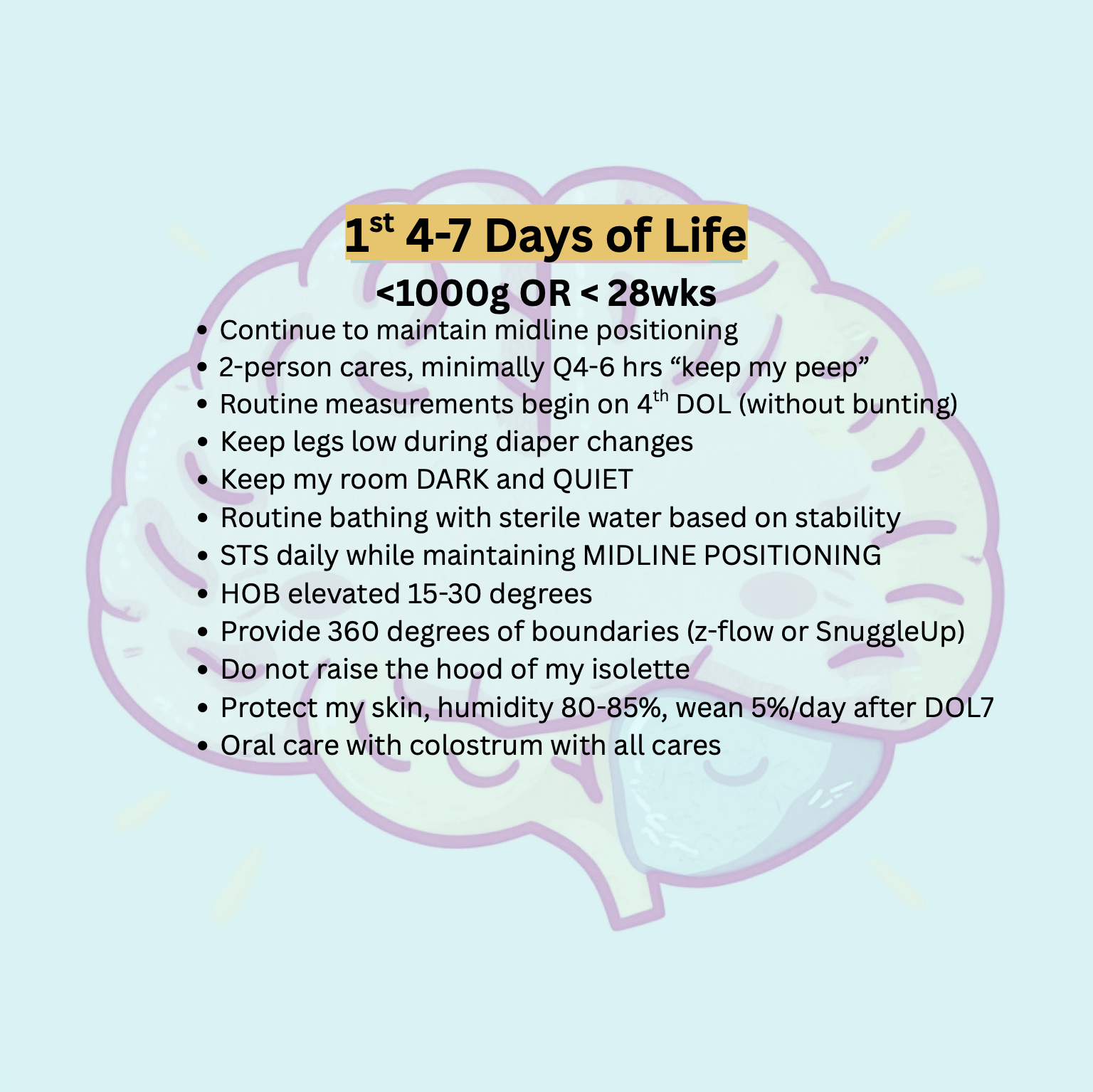
4 to 7 days of life
Section titled “4 to 7 days of life”