
System-Based ProtocolsChapter 18
Hematology & Oncology
Neonatal Indirect Hyperbilirubinemia
Section titled “Neonatal Indirect Hyperbilirubinemia”Transcutaneous bilirubin (TCB)
Section titled “Transcutaneous bilirubin (TCB)”Timing
Section titled “Timing”- qAM first 10 days of life
- Clinically indicated
Threshold for follow-up blood test
Section titled “Threshold for follow-up blood test”| Gestational Age | TCB threshold | Notify MD if: |
|---|---|---|
| < 28 weeks CGA | ≥2 mg/dl | ≥5 mg/dl |
| 28-29 weeks CGA | ≥3 mg/dl | ≥6 mg/dl |
| 30-31 weeks CGA | ≥5 mg/dl | ≥8 mg/dl |
| 32-33 weeks CGA | ≥7 mg/dl | ≥10 mg/dl |
| 34 weeks CGA | ≥9 mg/dl | ≥12 mg/dl |
| For ≥35 weeks CGA, use www.bilitool.org (up to 146 hrs) or www.peditool.org (for > 146 hrs): If TCB in high-intermediate risk zone (>75%ile of Bhutani nomogram) or TCB ≥13, draw stat TSB and notify MD if TSB is high-risk zone or ≥13 mg/dl | ||
Additional TCB screening for DAT+
Section titled “Additional TCB screening for DAT+”flowchart TD A["DAT+ and GA ≥ 32wks"] --> B["Check TCB at 6 hrs"] B --> C["If TCB <4, continue regular screening"] B --> D["If TCB 4-5, repeat TCB at 12 hrs"] B --> E["If TCB ≥ 5, draw TSB. Notify MD if TSB ≥ 5"] D --> E
Phototherapy for preterm infants
Section titled “Phototherapy for preterm infants”| Phototherapy | Exchange transfusion | |
|---|---|---|
| Gestational age (week) | Total serum bilirubin (mg/dl) | Total serum bilirubin (mg/dl) |
| < 28 0/7 | 5-6 | 11-14 |
| 28 0/7 - 29 6/7 | 6-8 | 12-14 |
| 30 0/7 - 31 6/7 | 8-10 | 13-16 |
| 32 0/7 - 33 6/7 | 10-12 | 15-18 |
| 34 0/7 - 34 6/ | 12-14 | 17-19 |
IVIG for ABO incompatibility
Section titled “IVIG for ABO incompatibility”- Dose: 1g/kg/dose
- Administration instruction: 1mg/kg/min for the first 30 min; if tolerated, increase gradually to a maximum of 8mg/kg/min. Total administration time: 6 hrs.
Alpha-fetoprotein (AFP) Reference Range
Section titled “Alpha-fetoprotein (AFP) Reference Range”Term infants (GA ≥ 37wks) without additional risk factors for AFP elevation
Section titled “Term infants (GA ≥ 37wks) without additional risk factors for AFP elevation”Preterm infants (GA < 37wks) without additional risk factors for AFP elevation
Section titled “Preterm infants (GA < 37wks) without additional risk factors for AFP elevation”Show the values
| Age (days) | AFP mean (ng/mL) | AFP 95% confidence interval (ng/mL) |
|---|---|---|
| 0 | 158,125 | 31,261-799,834 |
| 1 | 140,605 | 27,797-711,214 |
| 2 | 125,026 | 24,717-632,412 |
| 3 | 111,173 | 21,979-562,341 |
| 4 | 98,855 | 19,543-500,035 |
| 5 | 87,902 | 17,378-444,631 |
| 6 | 77,625 | 15,346-392,645 |
| 7 | 69,183 | 12,589-349,945 |
| 8-14 | 43,401 | 6,039-311,889 |
| 15-21 | 19,230 | 2,667-151,356 |
| 22-28 | 12,246 | 1,164-118,850 |
| 29-45 | 5,129 | 389-79,433 |
| 46-60 | 2,443 | 91-39,084 |
| 61-90 | 1,047 | 19-21,878 |
| 91-120 | 398 | 9-18,620 |
| 121-150 | 193 | 4-8,318 |
| 151-180 | 108 | 3-4,365 |
| 181-270 | 47 | 8-2,630 |
| 271-360 | 18 | 4-832 |
| 361-720 | 4 | 0-372 |
Reference
Section titled “Reference”- M. E. G. Blohm, D. Vesterling-Hörner, G. Calaminus & U. Göbel (1998) Alpha1-Fetoprotein (AFP) Reference Values in Infants up to 2 Years of Age, Pediatric Hematology and Oncology, 15:2, 135-142, DOI: https://doi.org/10.3109/08880019809167228
Anemia of Prematurity Management for ELGAN/ELBW
Section titled “Anemia of Prematurity Management for ELGAN/ELBW”Background
Section titled “Background”Extremely low gestational age neonates (ELGAN) / extremely low birth weight (ELBW) infants are born with lower hematocrit and hemoglobin levels.
Reference Ranges at Birth
Section titled “Reference Ranges at Birth”| Week of GA | RBC (×10¹²/L) | Hemoglobin (g/dL) | Hematocrit (%) | Mean Corpuscular Volume (fL) |
|---|---|---|---|---|
| 18–21 | 2.85 ± 0.36 | 11.7 ± 1.3 | 37.3 ± 4.3 | 131.11 ± 10.97 |
| 22–25 | 3.09 ± 0.34 | 12.2 ± 1.6 | 38.6 ± 3.9 | 125.1 ± 7.84 |
| 26–29 | 3.46 ± 0.41 | 12.9 ± 1.4 | 40.9 ± 4.4 | 118.5 ± 7.96 |
| >36 | 4.70 ± 0.40 | 16.5 ± 1.5 | 51.0 ± 4.5 | 108.0 ± 5.00 |
Anemia of prematurity is an earlier and more dramatic physiologic anemia that occurs in preterm infants, often around 4–6 weeks of age, with hemoglobin nadirs of 7–10 g/dL (hematocrit 21–30%).
Common symptoms (when present): tachycardia, pallor, poor feeding, reduced weight gain.
Most infants remain asymptomatic.
Key Evidence Notes
Section titled “Key Evidence Notes”- Early high-dose EPO is safe in GA ≤ 26 weeks but does not improve short- or long-term outcomes (Juul et al. 2020).
- pRBC transfusions may be associated with transfusion-related acute lung injury (TRALI) and transfusion-associated necrotizing enterocolitis (ta-NEC), although evidence remains limited and inconsistent (Maria et al. 2017; Khashu et al. 2022).
Management
Section titled “Management”General Measures to Optimize Blood Volume and Reduce Iatrogenic Loss
Section titled “General Measures to Optimize Blood Volume and Reduce Iatrogenic Loss”- Deferred cord clamping for up to 60 seconds in infants with good tone in the delivery room (NRP 9th edition).
- Correlate serum electrolytes with ABG electrolytes (Na, K, iCa) and trend using ABG when frequent monitoring is required.
Attempt daily correlation during the acute phase. - Combine laboratory tests whenever possible to minimize blood draws.
Epogen (EPO) Therapy
Section titled “Epogen (EPO) Therapy”- May be started earlier than 7 days of life if there is a rapid drop in hematocrit (at the discretion of the neonatologist) or if Hct < 32%.
- From the PENUT trial: Safe to administer from birth. No significant benefit in short- or long-term outcomes, but associated with fewer pRBC transfusions (2 [0–5] vs 4 [2–7]).
- Dose: 400 U/kg on Monday, Wednesday, and Friday.
Iron Therapy
Section titled “Iron Therapy”- Begin once the infant tolerates 100 mL/kg/day of enteral feeds.
- Dose: 3 mg/kg/day divided twice daily.
Packed Red Blooc Cell (pRBC) Transfusion
Section titled “Packed Red Blooc Cell (pRBC) Transfusion”For non-urgent transfusions: The outgoing and incoming neonatologists should discuss and agree on the necessity prior to proceeding.
1. Determine if Infant is Acutely Ill
Section titled “1. Determine if Infant is Acutely Ill”| Category | Not Acutely Ill | Acutely Ill |
|---|---|---|
| Respiratory | FiO₂ < 30% on invasive ventilation with adequate support FiO₂ < 40% on non-invasive ventilation with adequate support | FiO₂ ≥ 30% on invasive ventilation despite adequate support FiO₂ ≥ 40% on non-invasive ventilation despite adequate support |
| Metabolic | No acute severe metabolic acidosis | Acute severe metabolic acidosis (pH < 7.2, BE < -6, or HCO₃ < 12) |
| Clinical Status | Not on NEC watch Not undergoing sepsis evaluation No upcoming surgery No recent major bleeding Asymptomatic | On NEC watch Being evaluated for sepsis Upcoming surgery Major bleeding (e.g., Grade 3 IVH, pulmonary hemorrhage) within 3 days Symptomatic |
2. Transfusion Thresholds
Section titled “2. Transfusion Thresholds”| Time Period | Hemoglobin (g/dL) – Not Acutely Ill | Hemoglobin (g/dL) – Acutely Ill | Hematocrit (%) – Not Acutely Ill | Hematocrit (%) – Acutely Ill |
|---|---|---|---|---|
| DOL 0–7 | 10 | 11 | 30 | 33 |
| DOL 8–14 | 8.5 | 10 | 25 | 30 |
| DOL ≥ 15 | 7 | 9 | 21 | 27 |
3. Transfusion Volume
Section titled “3. Transfusion Volume”- Standard: 10–15 mL/kg over 4 hours.
- If 20 mL/kg is required: Consider splitting into two 10 mL/kg aliquots, each over 4 hours (total 8 hours).
4. NPO Practice
Section titled “4. NPO Practice”- Keep NPO for 1 hour before and 1 hour after transfusion.
5. Transfusion Routes
Section titled “5. Transfusion Routes”- UVC
- UAC
- PIV
- IO
References
Section titled “References”- Juul, Sandra E., et al. 2020. “A Randomized Trial of Erythropoietin for Neuroprotection in Preterm Infants.” The New England Journal of Medicine 382 (3): 233–43.
- Khashu, Minesh, et al. 2022. “Current Understanding of Transfusion-Associated Necrotizing Enterocolitis: Review of Clinical and Experimental Studies and a Call for More Definitive Evidence.” Newborn 1 (1): 201–8.
- Maria, Arti, Sheetal Agarwal, and Anu Sharma. 2017. “Acute Respiratory Distress Syndrome in a Neonate Due to Possible Transfusion-Related Acute Lung Injury.” Asian Journal of Transfusion Science 11 (2): 203–5.
Consent
Section titled “Consent”Refer to Blood transfusion for very and extremely preterm infants.
Section titled “Refer to Blood transfusion for very and extremely preterm infants.”Blood consent documentation
Section titled “Blood consent documentation”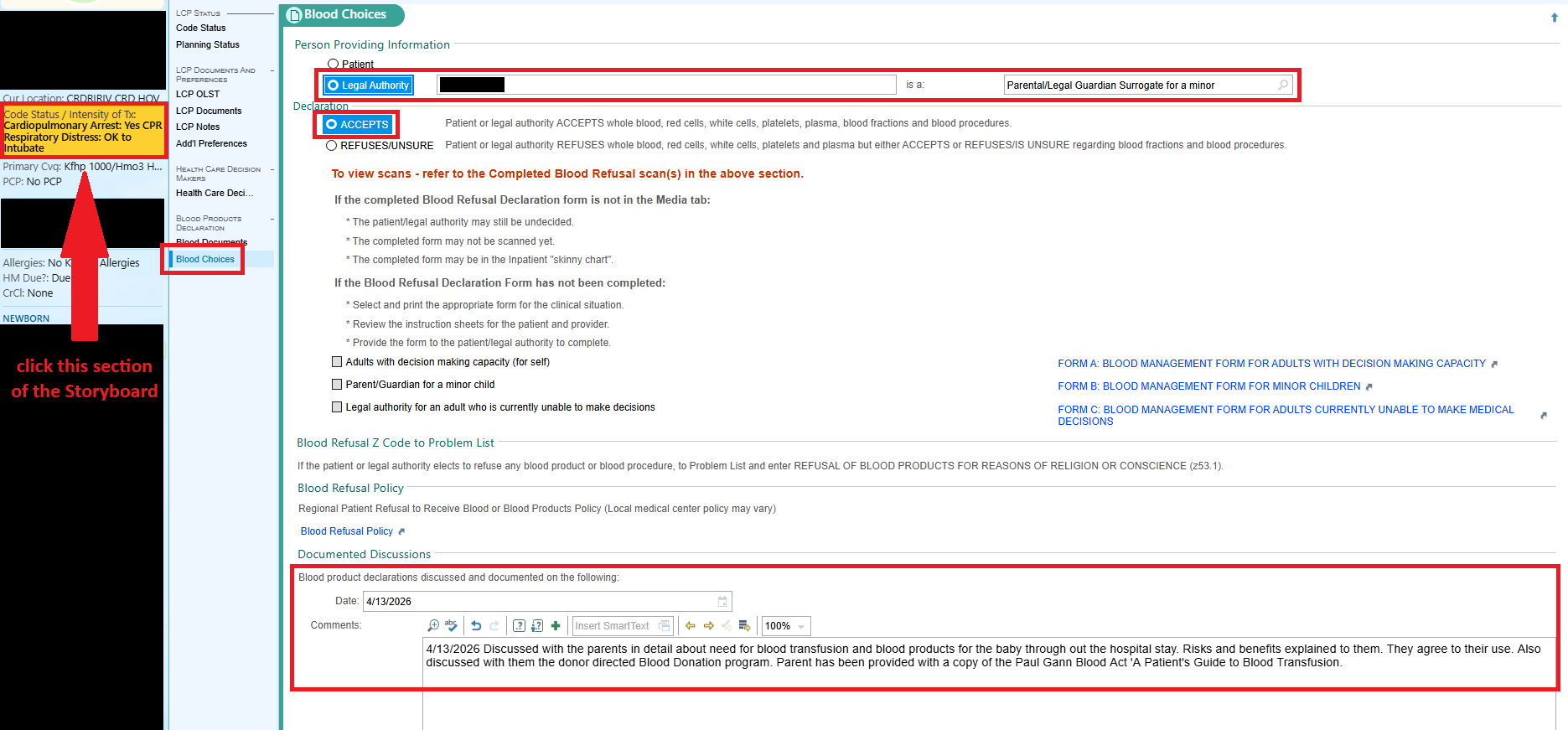
Procedure
Section titled “Procedure”- Transfuse over 4 hours with 1 hour NPO before and after transfusion.
- 15 (10-18) ml/kg per aliquot. If needing 20ml/kg, consider splitting into 2 aliquots.
Order Blood for Transfusion
Section titled “Order Blood for Transfusion”- The BPAM BLOOD TRANSFUSION (ML) LESS THAN 20-30 KG BODY WEIGHT Order Set should be used when ordering any blood product and will automatically prompt you to enter all the information needed, so you should not have to write a separate “transfuse” order.

Orderset
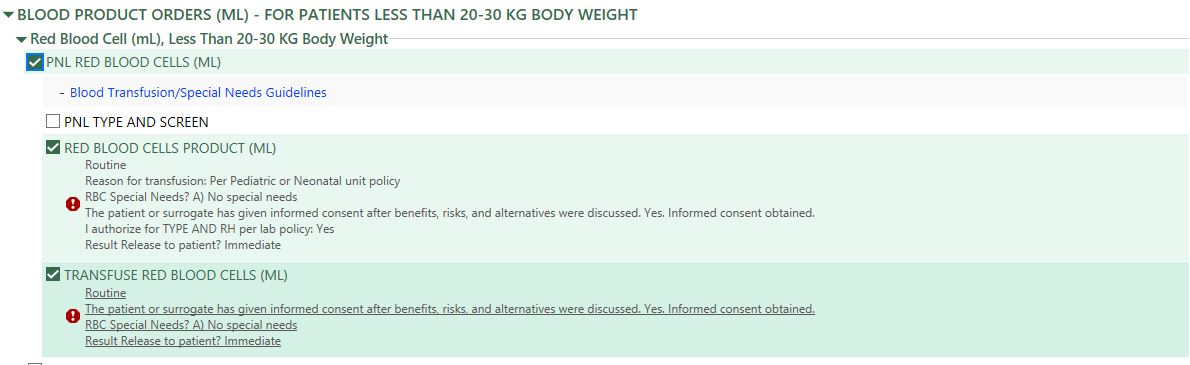
Orderset expanded
- In the case of emergency blood, we are still able to obtain uncross matched O- PRBCs from blood bank WITHOUT an order, within 20 minutes.
- Please remember to document “Yes” under the Informed Consent Obtained section (unless it is an emergency transfusion and/or there was a reason that informed consent was not obtained). This is the section that the nurses reference to ensure that this has been done prior to beginning the transfusion and they document acknowledgement of that as well in their Flowsheet.
Click Here to view and download the workflow PDF.
Click Here to view and download the Provider Practice Alert PDF.
Emergency Blood Release
Section titled “Emergency Blood Release”TWO FORMS TO FILL OUT:
- Emergency Blood Release/Waiver Form (Download here)
- Blodo Order/Release During Hemorrhage Protocol Form (Download here)
Emergency Blood Release/Waiver Form
Section titled “Emergency Blood Release/Waiver Form”This needs a patient sticker and is walked down to blood bank by a member of the nursing team. This doesn’t need to be filled out completely or signed initially. There IS an expectation that it is completely filled out when we are able (when baby is more stable).
Blood Order/Release Hemorrhage Protocol Form
Section titled “Blood Order/Release Hemorrhage Protocol Form”This is more of a prompt that the nurse will need to follow when calling blood blank. It gives them all the information they need to initiate preparing blood/blood products.
Procedures
Section titled “Procedures”- Physician decide baby needs blood/blood products, calculates the amount and tells the nurse.
- Nurse collects/fills out Blood Order/Release Hemorrhage Protocol Form. Follow process instructions. (Once blood bank is notified prbc should be at bedside w/n 30 minutes, plt and FFP w/n 40 minutes).
- Nurse obtains Emergency Blood Release/Waiver, places patient sticker on form and walks it down to blood blank.
- Physician to place orders/fill out appropriate forms after patient stable enough to do so.
Hypercoagulability Work-Up
Section titled “Hypercoagulability Work-Up”Blood tests
Section titled “Blood tests”- Protein C/S
- Antithrombin III
- PT/INR
- aPTT
- Anti-cardiolipin IgG/IgM
- Factor V Leiden
- Glycoprotein IgG/IgM
Vitamin K Administration at Birth
Section titled “Vitamin K Administration at Birth”AAP policy statement summary
Section titled “AAP policy statement summary”Summary and Recommendations
-
Vitamin K Deficiency Bleeding (VKDB) remains a significant concern in newborn and young infants. Parenteral vitamin K has been shown to be the most effective way to prevent VKDB of the newborn and young infant, and the AAP recommends the following:
-
Vitamin K should be administered to all newborn infants weighing >1500 g as a single, intramuscular dose of 1 mg within 6 hours of birth.
-
Preterm infants weighing ≤1500 g should receive a vitamin K dose of 0.3 mg/kg to 0.5 mg/kg as a single, intramuscular dose. A single intravenous dose of vitamin K for preterm infants is not recommended for prophylaxis.
-
Pediatricians and other health care providers must be aware of the benefits of vitamin K administration as well as the risks of refusal and convey this information to the infant’s caregivers.
-
VKDB should be considered when evaluating bleeding in the first 6 months of life, even in infants who received prophylaxis, and especially in exclusively breastfed infants.
Dosing table
Section titled “Dosing table”| >1500g | 1 mg (0.5 mL) |
|---|---|
| 1000-1500g | 0.5 mg (0.25 mL) |
| 600-999g | 0.3 mg (0.15 mL) |
| 400-599g | 0.2 mg (0.1 mL) |
| <400g | 0.1 mg (0.05 mL) |